-
Event Date2026.10.23 - 2026.11.07
- Directions

- Directions
- Bookmark
- Share
- prev
- next
-
Shared Realm: Variants of Existence
-
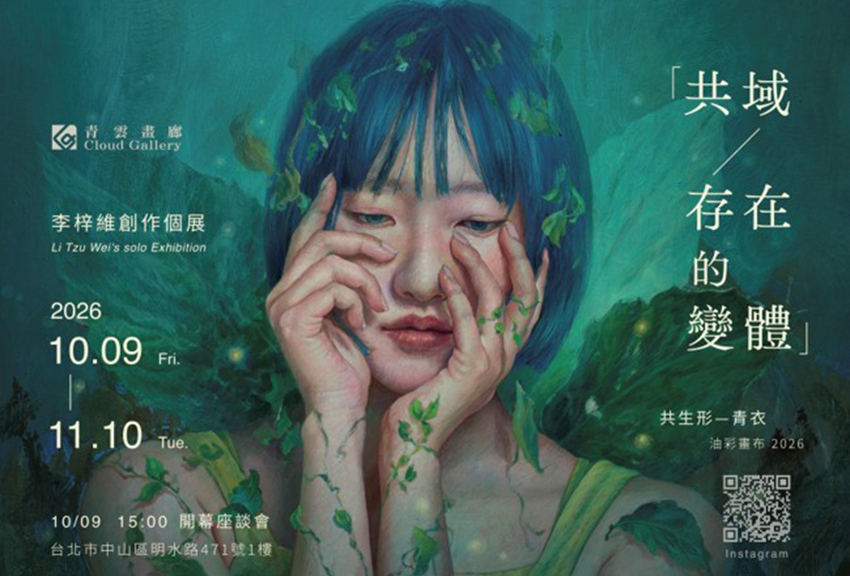
Where does the boundary between humanity and nature begin, and where does it dissolve? The exhibition Shared Realm: Variants of Existence focuses on two major creative trajectories of Taiwanese artist Li Tzu-Wei. Through the visual dialectics of "Landscape" and "Interwoven Flora and Human," the exhibition re-examines the interdependent relationship between individual perception and nature.
In Li Tzu-Wei’s brushwork, landscapes are never faithful representations of objective geography; rather, they are "psychological landscapes" formed by the repetitive layering and distilling of time, emotion, and memory upon the canvas. He captures ephemeral states of mountains, mist, and light, transforming reality into moments of eternity imbued with his inner spirit.
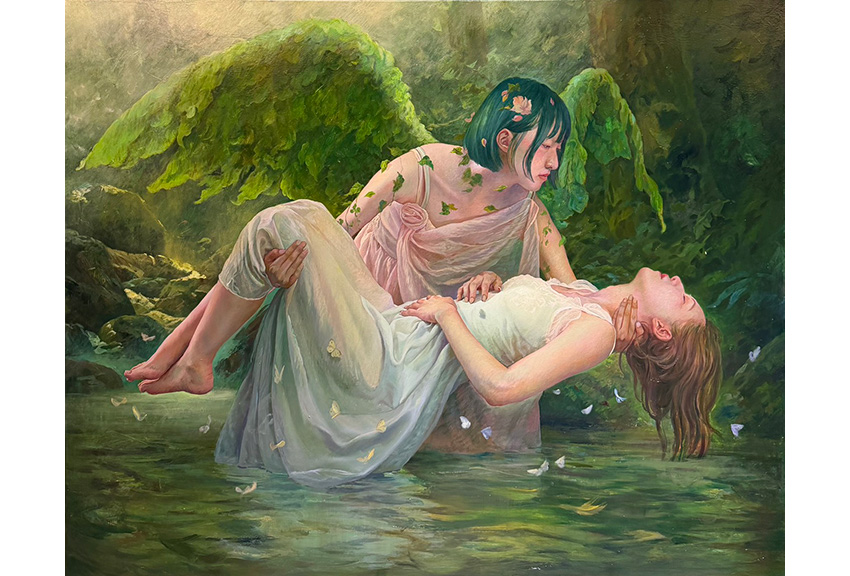
As the perspective shifts from the external environment to the internal self, the Interwoven Flora and Human series emerges. Inspired by Ovid’s Metamorphoses, the artist interlaces human skin, branches, and root systems, dissolving the rigid boundaries of the body. Here, vegetation is no longer a background or an ornament, but a living form that breathes and expands alongside the body.
This is a sensory experiment on metamorphosis and symbiosis. Through the refined textures of oil and water-based media, Li Tzu-Wei demonstrates that humans are not detached spectators standing outside of nature. As the body undergoes a botanical transformation, we continuously evolve through encounters with all things, identifying the most primitive and fluid state of life’s interdependence.
-
Shared Realm: Variants of Existence

- 2026.10.24 - 2026.11.07
- Tue. to Sat. 10:00 - 18:30
- Free Entry
- No. 469 & 471, Mingshui Road, Zhongshan District, Taipei City