
-
LocationAt the central green corridor, in the north-south direction
- Directions

- Artwork
- prev
- next
- Directions
- Bookmark
- Share
- prev
- next
-
Flowing Pavilion
-
HIGHLIGHT|CURATOR’S PICK
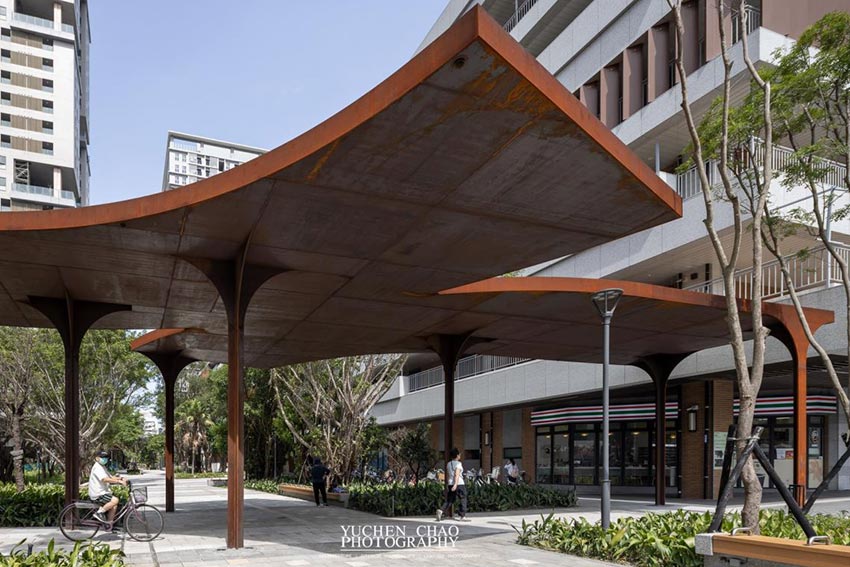
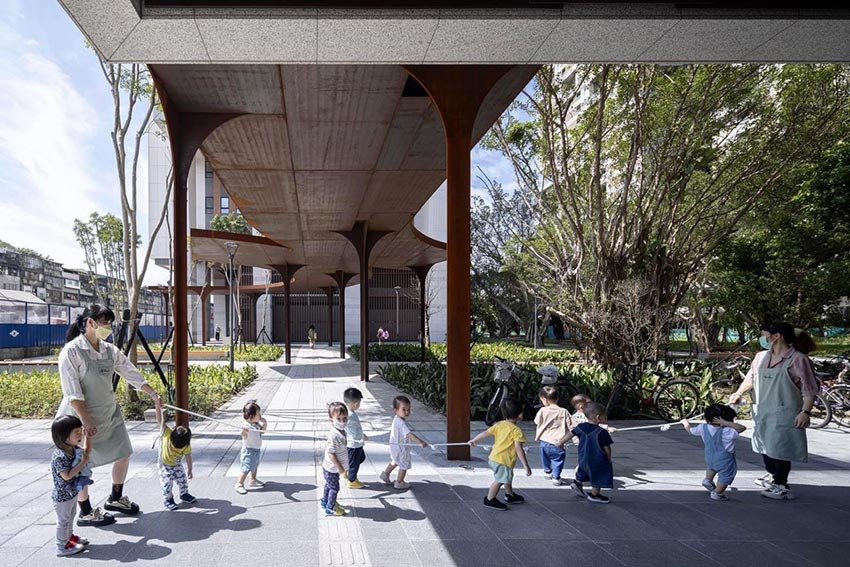
Flowing Pavilion is, at heart, the most ordinary covered walkway in the social housing complex—residents pass through it every day just to get from the Administrative Center to the Social Welfare Building. Yu-Chang Liang bends that walkway into two arcs that embrace the old trees, and where they meet, a small plaza opens up, letting a purely functional commute naturally grow corners where people stop to chat or cool off in the shade. The weathering steel rusts and changes color over time, aging alongside the old trees, together bearing witness to this community.
Artwork Description|
Starting from an urban design perspective, Yu-Chang Liang reimagined the space between the Administrative Center and the Social Welfare Building at Guangci Social Housing, integrating fragmented areas divided by clustered infrastructure. Through this artwork, the southern public space along the north-south central axis of Guangci Social Housing is re-anchored, giving it an elegant yet distinct character. The project not only establishes an urban-scale landmark but also creates a place for people to meet and interact.
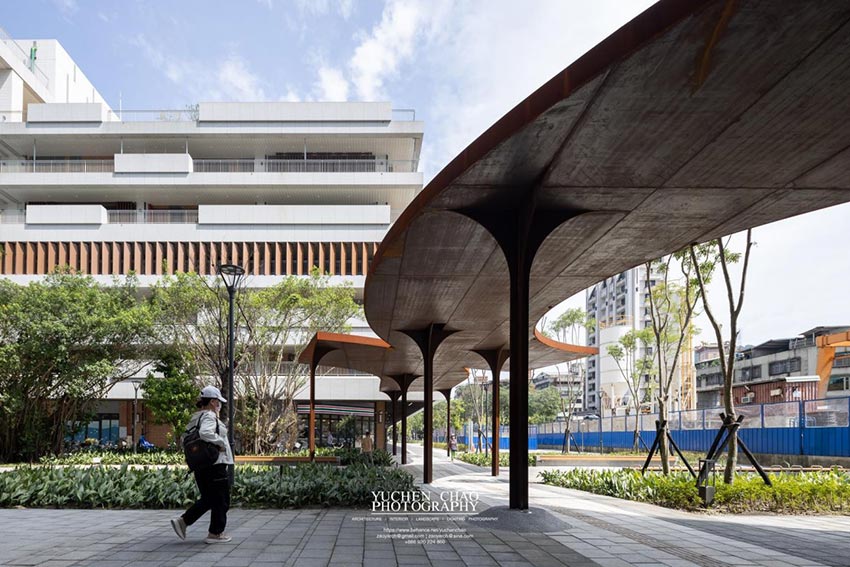
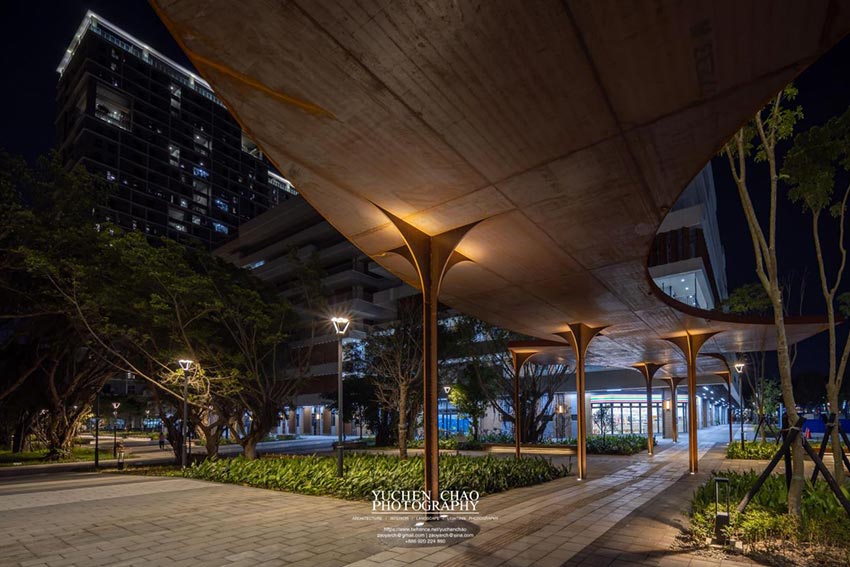
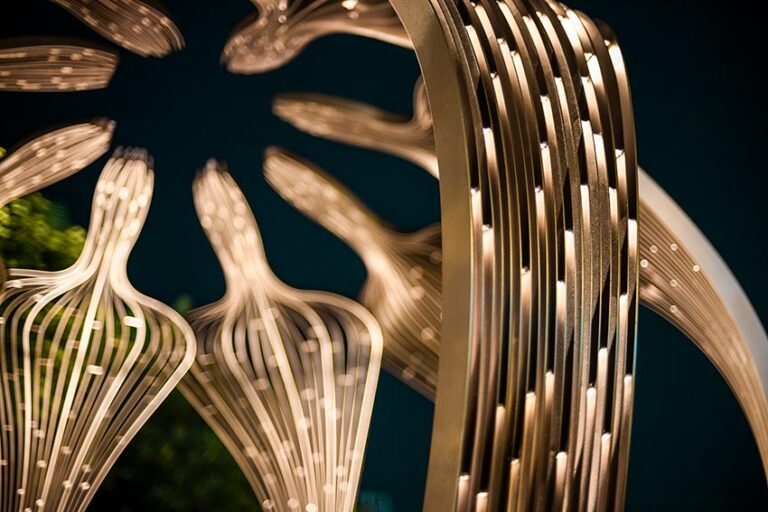
Building on the existing function of the covered walkway, the work features two opposing semicircular arcs forming a linear connecting passage. This design introduces a sense of rhythm and dynamic flow to the space. The north- and south-facing arcs create spatial ripples centered on the old trees, emphasizing the shaded areas along the central axis. These arcs extend toward the north and south, defining new spatial boundaries around the trees. Where the two arcs intersect at the center, slightly protruding eaves and columns define a new public plaza, giving the space sculptural qualities. The pavilion-like form naturally encourages lingering and rest, transforming this urban node into a place where residents, neighbors, and visitors converge and meet. The smooth circulation reinforces connections among the housing complex’s various facilities and the daily lives of residents and passersby.
Through careful observation and deep understanding of the spatial and environmental context, Yu-Chang Liang returns the agency of the space to its inhabitants with a humble and sincere approach. The artwork incorporates many protected old trees and planting beds, coexisting with nature, while using minimalistic geometric forms and the purest material textures and colors to evoke a strong spatial sensibility. The abstract, pure forms contrast with the organic spread of the two semicircular arcs embracing the clustered trees. Each form possesses its own posture, responding to the other, achieving harmony and balance through movement and stillness. This defines the overall tone and atmosphere of the site, creating a stage for future spatial narratives to unfold.
The entire work is made of weathering steel, its rich rusted tones simple and pure. Over time, a protective outer layer develops, corresponding with the surrounding natural trees. Both the sculpture and the trees witness the passage of time, celebrating life with respect and care. They accompany and safeguard the residents’ homes, bearing witness to the unfolding of a new urban life at Guangci Social Housing.
Source|Artfield
-
Flowing Pavilion
- Creator(s)Yu-Chang Liang X Architerior Architects
- Year of Creation2023
- Artwork DimensionsL2866 × W1858 × H460 (cm)
- SculptureSculpture/Weathering Steel, Permeable Pavement
- AddressNo. 86, Fude Street, Xinyi District, Taipei City
- Installation SiteAt the central green corridor, in the north-south direction
- Art Project“We Are Home” Xinyi District Guangci Bo'ai Social Housing Public Art Project
You May Also Be Interested In
Poetry of the Sun
- Kinetic Installation|2016
TAW INSTALLATIONS
Brightly Shines the Sun
- Kinetic Installation|2016
TAW INSTALLATIONS
Gathering Pavilion
- Sculpture|2023
TAW INSTALLATIONS